Database Errors Misidentify Hundreds of Telangana Villages as Having Zero Population
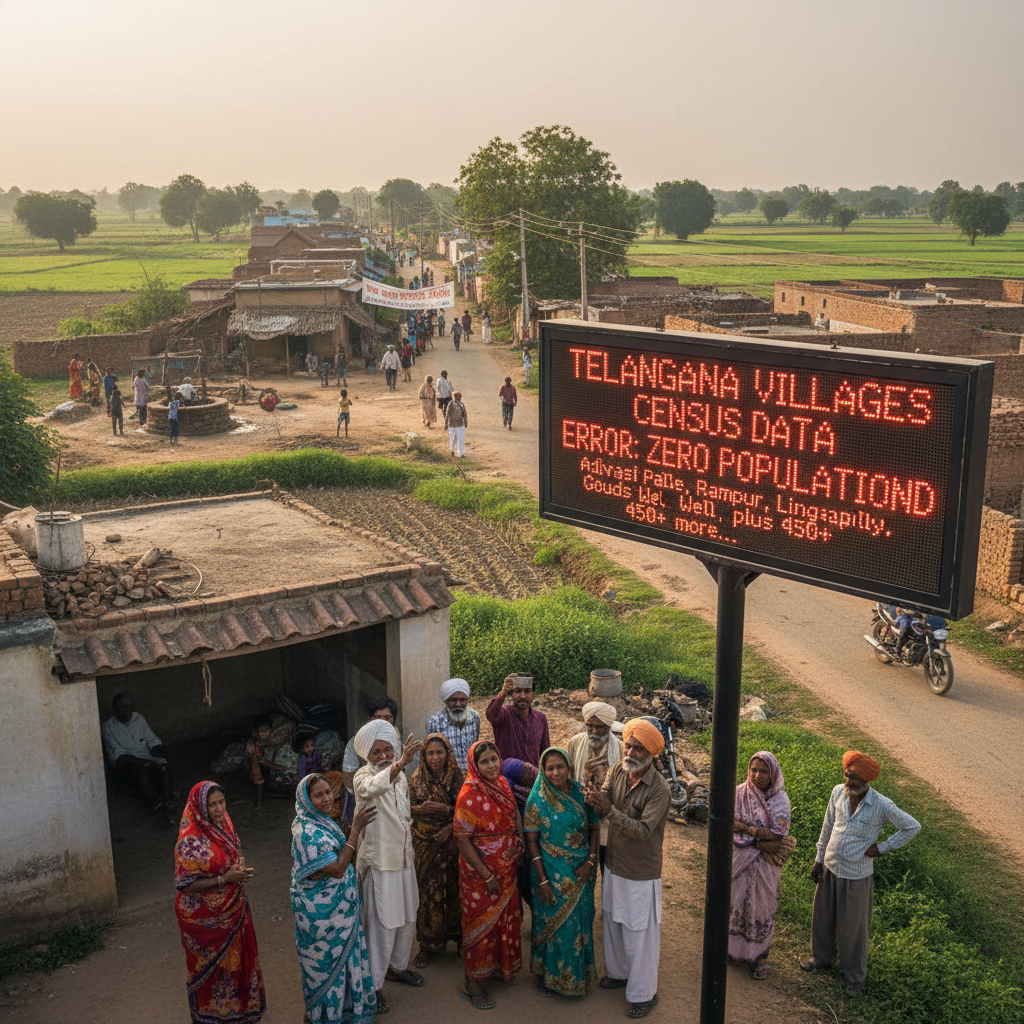
An investigation into the Union government's rural development database has revealed that many of Telangana's 1,080 supposedly 'zero-population' villages are not actually abandoned. The findings, published on May 31, 2026, expose critical data flaws including duplication, GPS errors, and conflicting entries within the Mission Antyodaya database, raising serious questions about the reliability of datasets used for welfare planning.
Although the latest Mission Antyodaya survey for 2022-23 identified 1,080 villages in Telangana as having zero population, an analysis of duplication patterns, infrastructure records, and GPS coordinates indicates that only around 491 villages can genuinely be classified as depopulated. Furthermore, the coordinates of more than 90 percent of the villages listed with no residents are glaringly inaccurate, suggesting that many of the surveys may never have properly reached the ground.
Specific cases highlight the extent of these database inconsistencies. For instance, the village of Narkhuda (Village code: 574731) in the Shamshabad block of RangaReddy district was recorded under three separate gram panchayats—Narkhuda, Kavvaguda, and Chowderguda—across all four Mission Antyodaya surveys.
Population figures for Narkhuda varied sharply across these entries. The Narkhuda gram panchayat entry recorded a decline from 5,179 residents in 2017-18 to 4,620 in 2019 and 2020, and 3,057 in 2022-23. Meanwhile, the Chowderguda entry recorded 3,459 residents in 2017-18, 4,620 in 2019, just a single resident in 2020, and zero in 2022-23. Conversely, the Kavvaguda entry showed a constant population of 2,010 across all survey rounds. Infrastructure data for the same village was equally conflicting, with Chowderguda reporting virtually no infrastructure while the other two entries recorded active infrastructure.
A similar pattern was found in Keli Khurd (Village code: 569270), located in the Kerameri block of Kumuram Bheem Asifabad district. The village was recorded under three separate gram panchayats: Khairi, Sangvi, and Keli-B.
The population under the Khairi gram panchayat entry declined from 417 in 2017-18 to 285 in 2019 and 2020, down to zero in 2022-23. The Sangvi entry recorded 545 in 2017-18, 285 in both 2019 and 2020, and 505 in 2022-23. The Keli-B entry, which did not exist in the 2017-18 survey, recorded 285 residents in 2019 and 2020, before increasing to 505 in 2022-23. Infrastructure records for these entries also showed highly conflicting indicators across all survey rounds.
These widespread errors cast doubt on the credibility of the Mission Antyodaya dataset. Because the Union government relies on this database for village-level governance, infrastructure distribution, and welfare scheme planning, these data flaws could have significant policy implications for rural development across Telangana.