Hyderabad Commuters Report Smoother Drives on New KBR Park One-Way Traffic Loop
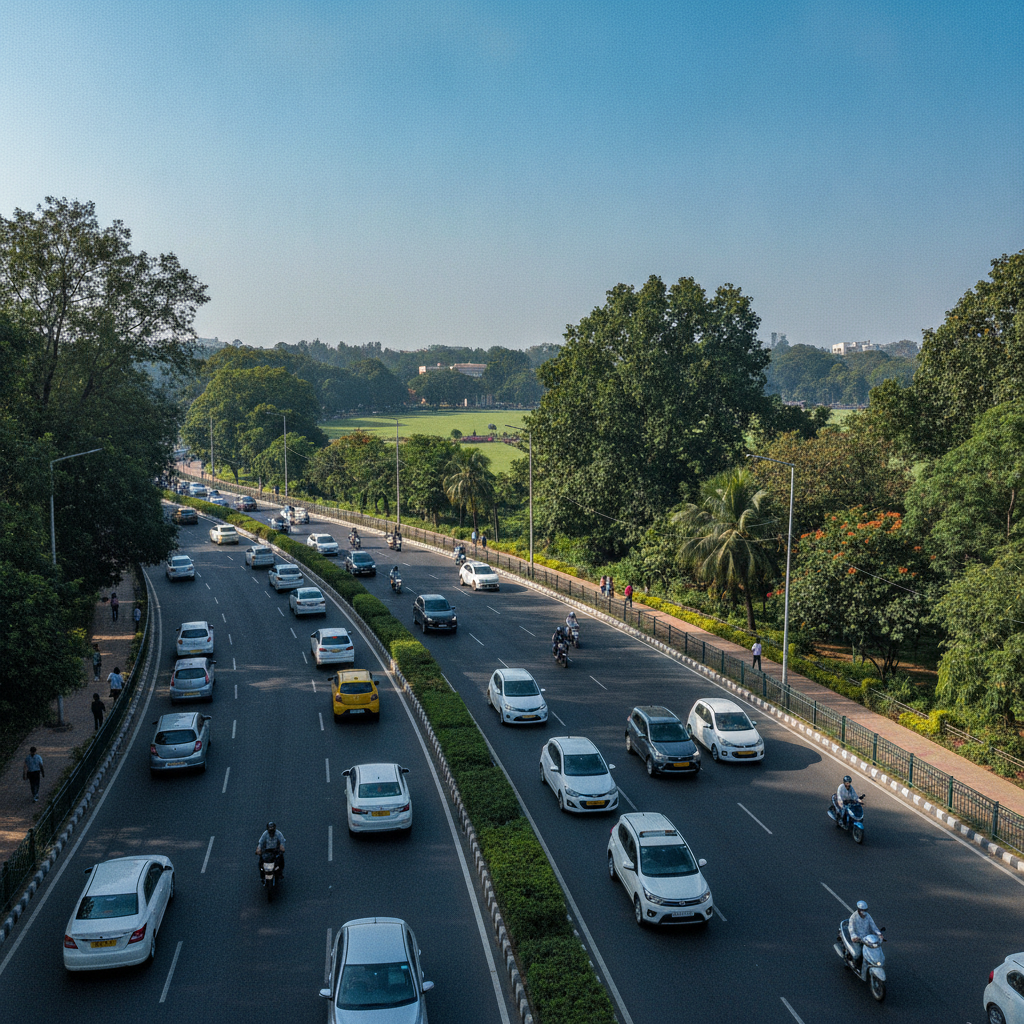
Motorists navigating the one-way traffic loop introduced around Kasu Brahmananda Reddy (KBR) Park in Hyderabad are reporting smoother travel and significantly less stress, even though the new system requires a longer detour. The revised traffic arrangement, which was implemented around ten days ago, has largely eliminated the constant stopping and starting at signals that previously caused severe congestion.
Commuters and ride-hailing drivers noted that while the new route adds a few extra minutes to their journey time, it has substantially reduced bumper-to-bumper traffic and conflicts on the road. Many drivers expressed relief that the chaotic snarls around the park perimeter have subsided, leading to a more predictable and comfortable commute.
Despite the overall improvement, motorists have flagged specific points of confusion regarding lane changes, particularly near the Study Circle at Indo-American Cancer Hospital. Auto driver Srisailam noted that while movement remains clear at KBR Junction, drivers face uncertainty at the Study Circle when deciding whether to head towards the Indo-American Cancer Hospital or take the parallel stretch leading to Maharaja Agrasen Island.
Similar challenges were reported by commuters travelling from Film Nagar and Jubilee Hills towards the Jubilee Hills Check Post metro station. Commuter Rameshwara Rao pointed out that uncertainty arises when vehicles make sudden movements either towards the Chiranjeevi Blood Bank or back towards KBR Junction.
Traffic also continues to slow down during evening peak hours between 7 pm and 10 pm. Motorists observed congestion primarily concentrated near the Indo-American Cancer Hospital, Maharaja Agrasen Island, and Film Nagar during these hours.
Some residents suggested that the Greater Hyderabad Municipal Corporation (GHMC) should evaluate the long-term effectiveness of the one-way system before advancing larger infrastructure plans like the H-CITI Project. Commuter Adi Narayana suggested that if motorists adapt fully to the smooth flow of the one-way loop, the civic body may not require expensive flyovers or underpasses along the corridor.