IIIT Hyderabad Researchers Win Top Awards At CVPR 2026 AI Conference
Researchers from the Centre for Visual Information Technology (CVIT) at the International Institute of Information Technology, Hyderabad (IIIT, Hyderabad) won the Best Paper and Best Paper Runner-up awards at the Computer Vision and Pattern Recognition (CVPR) 2026 conference. The prestigious awards were presented at one of the world’s leading artificial intelligence (AI) conferences for breakthroughs that simplify complex 3D models and improve how computers understand videos.
The CVPR 2026 conference received more than 16,000 submissions, with only about a quarter of the papers being accepted. CVIT’s double win highlighted the Hyderabad-based institute’s significant contributions to computer vision, image generation, and document intelligence.
Master’s graduate Darshan Singh secured the Best Paper award for developing a method that improves how AI understands videos by using structured descriptions instead of massive datasets. Singh explained that while existing tools like CLIP are good at connecting images and text, video captions often leave out important details. By using semantic role labels, his team trained a strong video-understanding model using only a small amount of data.
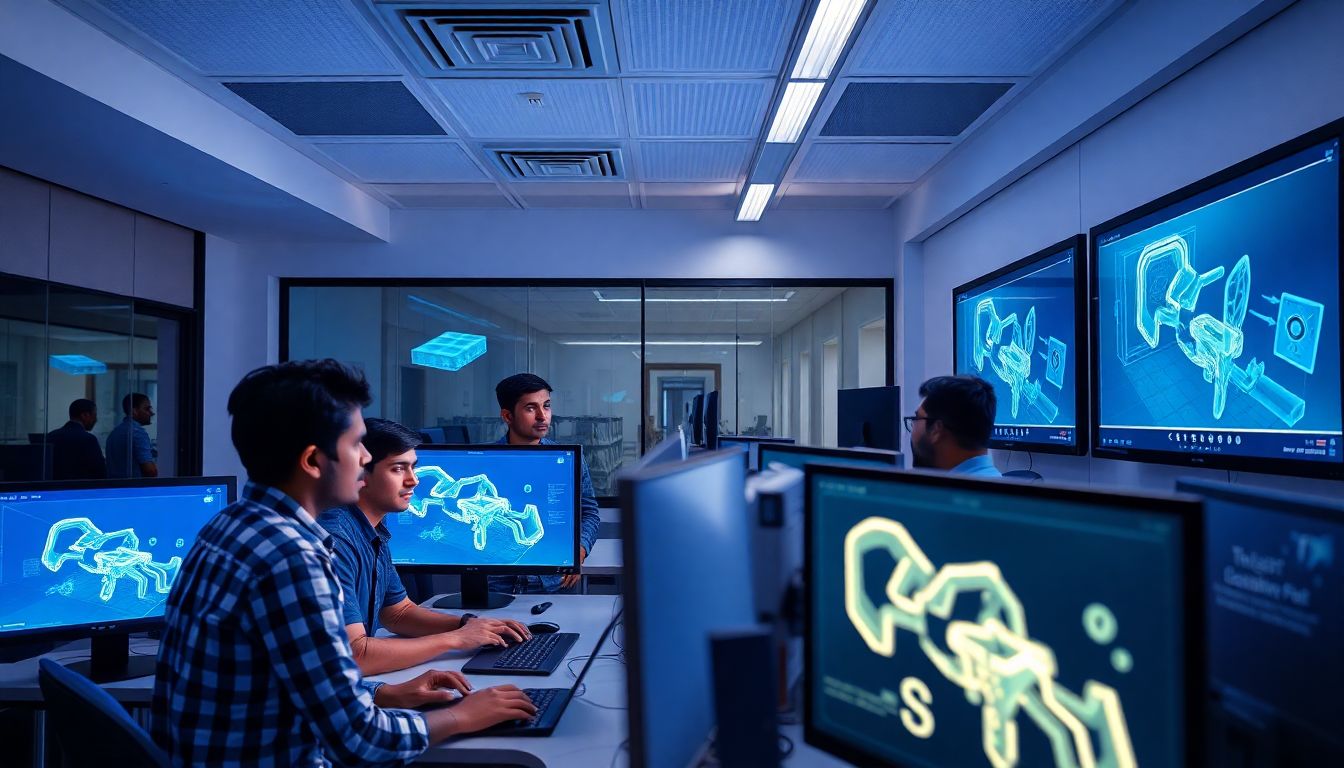
Dual degree graduate Kunal Bhosikar received the Best Paper Runner-up award for his research on simplifying AI-generated 3D models. Bhosikar noted that while modern AI systems can generate detailed 3D models from images, videos, and text prompts, these models contain thousands of tiny triangles that make them expensive to store and process. His technique removes unnecessary triangles while preserving the shape and texture, making the models much faster to use.
In addition to his award-winning work, Bhosikar presented another paper focused on protecting photographs from unauthorized 3D reconstruction. This method uses an almost invisible digital patch that disrupts AI reconstruction pipelines while remaining unnoticed by humans.
Other researchers from the institute also showcased their work at the conference. Vaibhav Agrawal presented SeeThrough3D, a project designed to help AI understand occlusion, which is when one object partially blocks another. This tool allows artists to control the position and pose of every object more accurately. Another team, led by Prof. Ravi Kiran, developed RoadTones, which teaches AI to describe the same road incident differently depending on the audience.
Professor C.V. Jawahar delivered the keynote address at the workshop, and an earlier CVIT paper received the EgoVis distinguished paper award.