Matti Foundation discovers ancient rock paintings at Maisamma Gutta
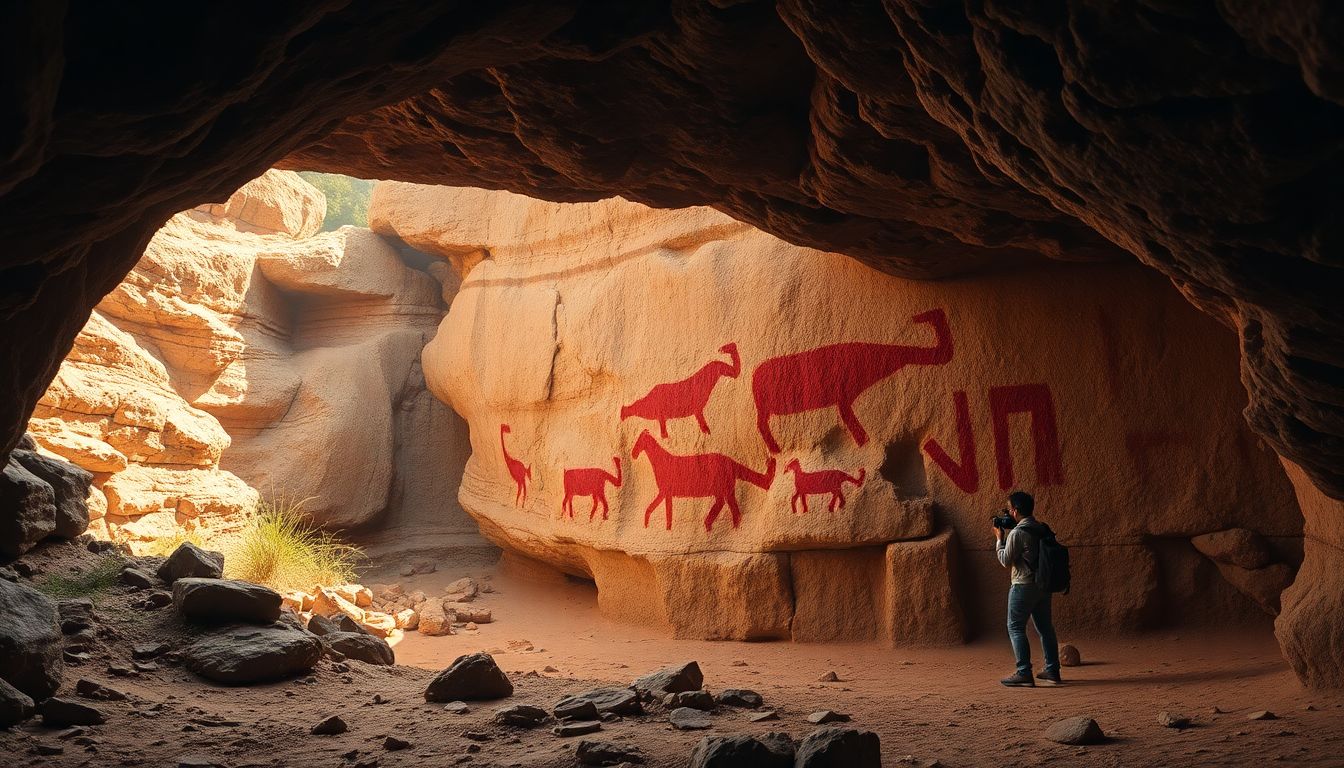
On July 11, history enthusiasts from the NGO Matti Foundation discovered ancient rock paintings and prehistoric stone tools at a rock shelter in Maisamma Gutta, located on the outskirts of Gannevanipalli village in Mustabad mandal, Rajanna Sircilla district. The discovery has sparked a debate among experts due to one of the red-ochre figures resembling a kangaroo, a species not native to the region.
The team, led by history enthusiast Reddy Ratnakar Reddy, scaled the hill and reached an east-facing rock shelter after navigating through thorny bushes. Inside, they found several paintings made with red and dark-red pigments.
The most controversial painting depicts a light-red, filled-in animal with an elongated body, one eye, ears, and a long, thick tail. While the Matti Foundation suggested the figure resembles a grazing kangaroo, rock art specialists have urged caution. One expert noted that a kangaroo identification is highly unlikely and suggested the figure looks more like a jackal.
Other motifs recorded at the rock shelter include a sun motif, a tortoise, a lizard, a snake, and five-pointed stars drawn in a single continuous stroke. Another figure on the ceiling has a small head and a body covered with spine-like markings, while a dark-red animal figure remains unidentified.
In addition to the paintings, the team found Palaeolithic and microlithic tools near Maisamma Gandi at the foot of the hill, as well as on flat rocks along the nearby Nakka Vagu. Deep grooves on a rock surface in front of the shelter suggest prehistoric communities repeatedly ground or sharpened stone tools there.
The team also discovered hematite, an iron-rich mineral used as a red pigment, near the shelter. The Matti Foundation suggested that prehistoric communities powdered this mineral and mixed it with animal fat or plant gum to prepare their paint.
Based on the overlapping images and the stone tools, the foundation proposed that the Gannevanipalli paintings could date back to the early Mesolithic and Neolithic phases, with the earliest possibly dating to 10,000 BC. However, these dates have not yet been scientifically established.
Currently, local residents worship the site as Maisamma. Some of the paintings have become difficult to recognise due to rainwater damage and the application of lime. The Matti Foundation has appealed to the archaeology department to conduct a scientific study to determine the age of the paintings, establish the identity of the animal figures, and protect the site.